
INAUGURAL EXHIBITION
James Surls
From the Old Growth
September 19 – xxx, 2026
Passage Arts is thrilled to present a major exhibition by James Surls. This gathering of work, ranging from the mid 1990s to the present, will not be seen again in a similar context and is unlike any previous James Surls's career exhibition, establishing his legacy as a prophetic visionary and iconic American artist.
Essay by Susie Kalil
For several decades, James Surls's sculptures have awakened the imagination to new realms and forced an exploration of unfamiliar emotional terrain through the use of universal symbols—the hand, flower, bird, bridge, diamond, needle, and knife. They evoke a sense of ancient, present and future worlds, a movement from visible nature to the inner eye. And like nature, nothing is ever still. Look into Surls's work at any given point: the world of it is growing, extending, solid and moving in time. In the recent drawings, reality is in a constant fluid state with no hard boundaries, moving freely according to the transformations of the mind. The issue is how we pay attention to things in the world.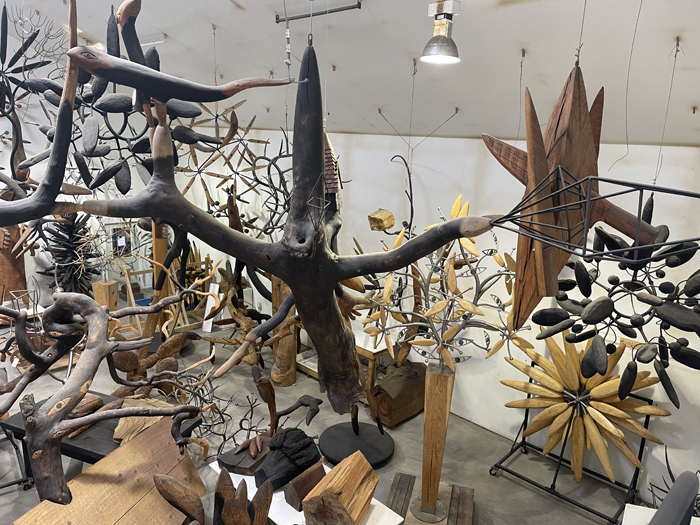
Within Buddhist meditation there is a persistent focus on cultivating one's capacity to be present with things as they are, to see each thing, each being, each moment as though for the first time and to recognize those various states of consciousness. As life speeds up and further complicates our experience, we should value any opportunity to be still, to let the mind rest, to allow true seeing to take place. The process of looking at occurs all the time. But true seeing is rare. It asks for the cultivation of intimate ways of being in the world that give the heart the emotional affinity it requires and the skin the brush with real things it craves. Surls's unabashed sensuality and attention to process—to full throttle gesture and minute calibrations of the hand—give his works an undeniably tactile presence, while his fantastic and enigmatic imagery reaches down to the primitive and primal and out to the frontiers of space and the cosmos.
Partly melancholic and partly compulsive—desirous, fierce—the drawings are mesmerizing meditations on dissonance and harmony. Surls's formal anarchy reads as a metaphor for the randomness of life's events. Accordingly, we enter a world where shifts, ruptures and fissures are part of the natural flow. Order and stasis, his work tells us, are illusions. Entropy, decay, disruption and chaos are part of the process to which we must all submit if we are to have any understanding of where and how we exist in time. Looking at the drawings can produce vertigo, as if we've been through some kind of maelstrom and have yet to reach a state of calm. How do we feel ourselves as human beings—our sensation of being alive, of individual existence? We continue to be aware of ourselves as isolated egos inside bags of skin, rather than as an expression of the whole realm of nature. The real "I," however, acknowledges that it is part of the perpetual transmutation of all forms. This realization has always been in us: our bodies know it. The numinous aspects may be linked to the wisdom of our ancestors or to a consciousness beyond the limits of the corporeal.
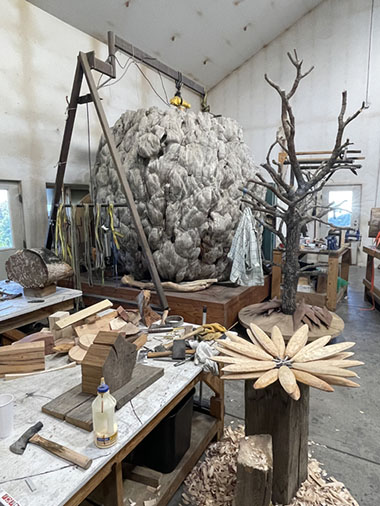
Details from James Surls's rural Colorado studio. Photo: Hills Snyder
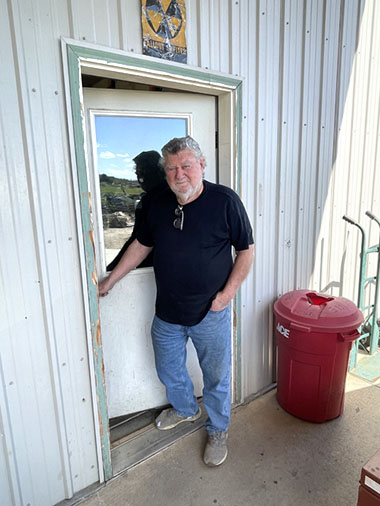
James Surls in front of his Carbondale, Colorado studio. Photo: Hills Snyder
For Surls, the body holds a contentious, fragile elusive truth. He valorizes the body as our primary means of experiencing the world, revels in its infinite mystery as the vessel of life, and respects its place within the cosmos. It is a universe animated by hidden forces, abundant in potentials but scarce in certainty. Her Universe Apart is as effective a rendering as exists of the profound torturing ambivalence with which we all regard where we come from. Here, Surls goes against religious thought by conferring a feminine deity at the helm of the universe. From the marrow of nature, can individual existence renew itself? A womblike form seemingly floats in its own separate cosmos, morphing and vibrating before our eyes. Circles, prisms and multiple strands of loose, pulsating lines form a protective barrier. The free, dense accumulation of myriad charged graphite strokes gathers momentum and fills the sheet in a dance to its own rhythm. Surls's ability to make each gesture an intuited yet carefully considered unit of sublimated feeling is what gives the vibrant lines their hypnotic power. Writhing embryonic shapes and complex molecular systems are turned into cosmic personifications of our flesh-against-spirit battles.
Surls reminds us that there is no other way into the universe except through the body of the female. His provocative rendering of the feminine forces us to look inside, to trust not only the spiritual life and high revelations, but also emanations from the depths. Yet the womb, the feminine, is not without its terrors. The webbing with interwoven "eyes" and interior threadlike crossings tap into archetypal memories of orifices, lairs and other strange places that seduce or frighten us. The female form is promising, giving and flowing but equally withholding, introverted and potentially dangerous. She is the vortex of the universe, which orbits this feminine core in an elliptical course, calm and balanced, but just as likely to become an ecstatic burst of erotic energy.
The drawing engenders something akin to sensory whiplash. We come up close and peer at the large-scale image—searching, scrutinizing, scanning—much the way Surls must have done while setting his sights on the seemingly infinite night sky of Colorado. There's the sense of a wildly querying intelligence suspended in a state of awe. The tension of this predicament—the need to push forward meeting the need to hold still—pervades Surls's style, which is one of skillful virtuosity, expansive focus and ambling centripetal force.
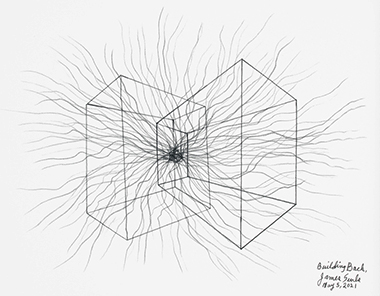
James Surls, Building Back, 2021, pencil on paper, 11 x 15 inches. Courtesy the artist
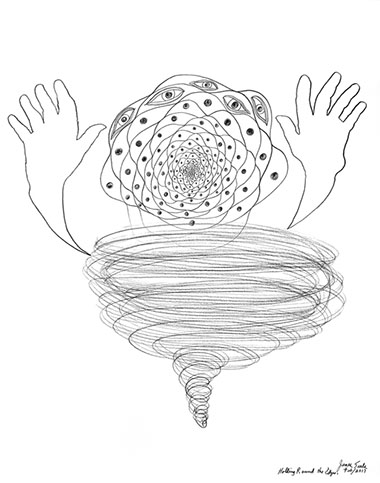
James Surls, Holding Round the Edges, 2017, pencil on paper, 40 x 32 inches. Courtesy the artist
Surls is drawn instinctively to moments, the way parcels of time expand and contract in memory, conjuring from ordinary experience a hidden sense of all that is extraordinary in the world, in being alive. In I am in the Good Bye Glove, he depicts the sensation of solid ground suddenly melting away, pinpointing that instant when the familiar present is swallowed up by an encroaching past or a voided future. At what point do we cease to be who or what we were and become something different? Here, chains of elliptical lines chase one another within a spiraling hive form. Large threads spread like cracks or charged synapses across the paper's surface. For Surls, the threads represent continuity in space and time, the very fabric of human existence. Black circles and dots hover midair, like portals onto other dimensions. Surls's line expands and contracts with full body movement. Instead of sentimentalizing or vindicating the world, however, Surls strips away false pretense to reveal undercurrents of anxiety and vulnerability. Reverberating layers of an open hand contain the artist's profile, which casts eyes and prisms across the cosmos. Seeming as far away as the moon and as near as arm's reach, the interplay of solids and voids portrays the universe within ourselves. Surls's line has the quality of a siren's call—seductive, elusive, utterly graceful. It curls and meanders, lithely, sensuously—and like the terms of mortality, it slips and dwindles away. The drawing hints at meanings beyond its immediate scope. It alludes to quantum mechanics, the architecture of the cosmos, probability and the heat of black holes and, finally, how we fit into this picture.
The work breathes life—Surls's fleeting life, as well as a moving portent of the transitory nature of our own existence. It serves as a reminder that humans are collectively engaged in some enormous, cosmically significant endeavor the nature of which hardly any one of us has an inkling. Surls implies that space is granular; time does not exist and things are nowhere. We are stardust, impossibly minor players in the pageant of the galaxies and well on our way to becoming the agents of our own demise.
